Welcome to Oregon Treatment Court Programs
Change Lives. Increase Public Safety. Decrease Future System Costs.
Treatment courts, which exist at the intersection of treatment and the justice system, seek to provide a compassionate, evidence-based approach to justice, public safety, accountability, and healing. These programs are designed to serve system-involved individuals who present with substance use disorders, mental health conditions and/or other behavioral health needs.
Treatment courts follow an evidence-based model in which a person’s behavior and progress are overseen by a multidisciplinary team through regular judicial reviews, community supervision and support, and structured treatment. Treatment Courts establish high standards for accountability. Participants must meet program requirements, including regular court appearances, compliance with treatment plans and, and ongoing monitoring including drug testing.
Oregon’s treatment courts are built on strong partnerships between judges, coordinators, prosecutors, defense attorneys, treatment providers, probation officers, law enforcement, child welfare, and other community organizations. Together, we work to reduce future system involvement, improve public safety, and support long-term recovery.
Treatment Courts Matter
Treatment courts are grounded in evidence demonstrating their effectiveness. Decades of research shows treatment courts are one of the most effective strategies for addressing substance use and behavioral health issues within the justice system (All Rise, n.d.). National studies consistently demonstrate that these programs:
- Increase public safety
- Reduce repeat offenses (recidivism)
- Reunite families
- Lower costs to the justice system and taxpayers
- Improve long-term recovery outcomes
History of Innovation in Oregon
Oregon has embraced the treatment court model since its inception. The state’s first adult drug court began in 1991. Since then, Oregon has expanded to include five additional treatment court program types:
- Family Treatment Courts
- Mental Health Courts
- Veterans Treatment Courts
- DUII Courts
- Juvenile Treatment Courts
Each program-type is tailored to meet the unique needs of the research-based target population while following the
Treatment Court Best Practice Standards and other relevant evidence-based practices.
Oregon Treatment Courts
Oregon’s treatment courts are governed by
ORS 3.450. The term “Treatment court program” means a program:
- In which individuals are before the court to obtain treatment for substance abuse issues, mental health issues or other behavioral health issues and report regularly to the court on the progress of their treatment
- In which a local treatment court team, consisting of the court, agency personnel and treatment and service providers, monitors the individual’s participation in treatment; and
- That substantially adheres to the treatment court standards developed by the Oregon Criminal Justice Commission under
ORS 137.680
The Oregon Judicial Department (OJD) is responsible for the operation and delivery of circuit court treatment court programs. The
Oregon Criminal Justice Commission (CJC) serves “as a clearinghouse and information center for the collection, preparation, analysis, and dissemination of best practices applicable to treatment courts.” (ORS 137.680). The CJC is responsible for maintaining, in consultation with the OJD, Oregon’s evidence-based standards for treatment courts. The standards are designed to reduce recidivism in a cost-effective manner and serve individuals identified as medium to high risk for future system involvement or failure on standard supervision.
Treatment court programs follow the
Oregon Treatment Court Standards, which combine national guidance on model framework (e.g.,
Defining Drug Courts: The Key Components) and research (e.g., the All Rise
Adult Treatment Court Best Practice Standards (PDF)) with Oregon specific considerations to guide treatment court operations.
In 2023, the CJC published a data brief demonstrating Oregon Treatment Courts effectiveness in reducing recidivism. According to this study, 75% of individuals who successfully completed a treatment court did not get rearrested within three years of program exit.
Types of Treatment Courts
- Adult Drug Courts
- DUII Treatment Courts
- Family Treatment Courts
- Juvenile Drug Treatment Courts
- Mental Health Courts
- Veterans Treatment Courts
Contact us
Email:
SCA.ESD.Treatment.Court.Staff@ojd.state.or.us
Active Treatment Court Program(s) Mapped by County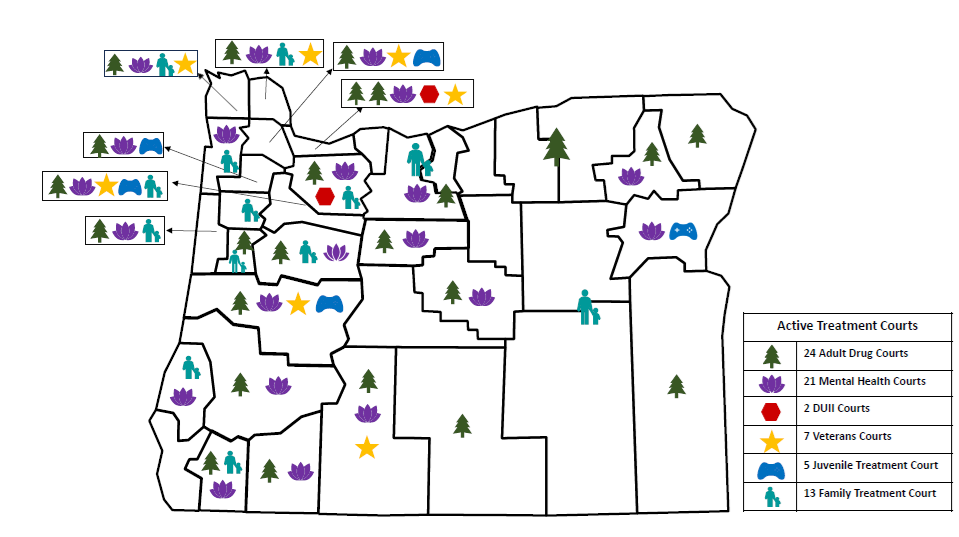
Active Treatment Court Program(s) Listed by County
Juvenile Treatment Court
Mental Health Court
Adult Drug Court
Family Treatment Court
Adult Drug Court
DUII Court
Family Treatment Court
Mental Health Court
Adult Drug Court
Family Treatment Court
Mental Health Court
Veteran Treatment Court
Adult Drug Court
Family Treatment Court
Mental Health Court
Veteran Treatment Court
Family Treatment Court
Mental Health Court
Adult Drug Court
Mental Health Court
Adult Drug Court
Mental Health Court
Adult Drug Court
Family Treatment Court
Mental Health Court
Adult Drug Court
Family Treatment Court
Mental Health Court
Adult Drug Court
Mental Health Court
Adult Drug Court
Mental Health Court
Adult Drug Court
Family Treatment Court
Mental Health Court
Adult Drug Court
Mental Health Court
Veteran Treatment Court
Adult Drug Court
Juvenile Treatment Court
Mental Health Court
Veteran Treatment Court
Adult Drug Court
Family Treatment Court
Mental Health Court
Adult Drug Court
Family Treatment Court
Mental Health Court
Adult Drug Court
Family Treatment Court
Juvenile Treatment Court
Mental Health Court
Veteran Treatment Court
Adult Drug Court
DUII Court
Mental Health Court
Veteran Treatment Court
Adult Drug Court
Family Treatment Court
Mental Health Court
Family Treatment Court
Mental Health Court
Adult Drug Court
Mental Health Court
Adult Drug Court
Family Treatment Court
Mental Health Court
Adult Drug Court
Juvenile Treatment Court
Mental Health Court
Veteran Treatment Court
Adult Drug Court
Juvenile Treatment Court
Mental Health Court